
Lore
The Crocodile God Who Walks in Sunlight and Shadow
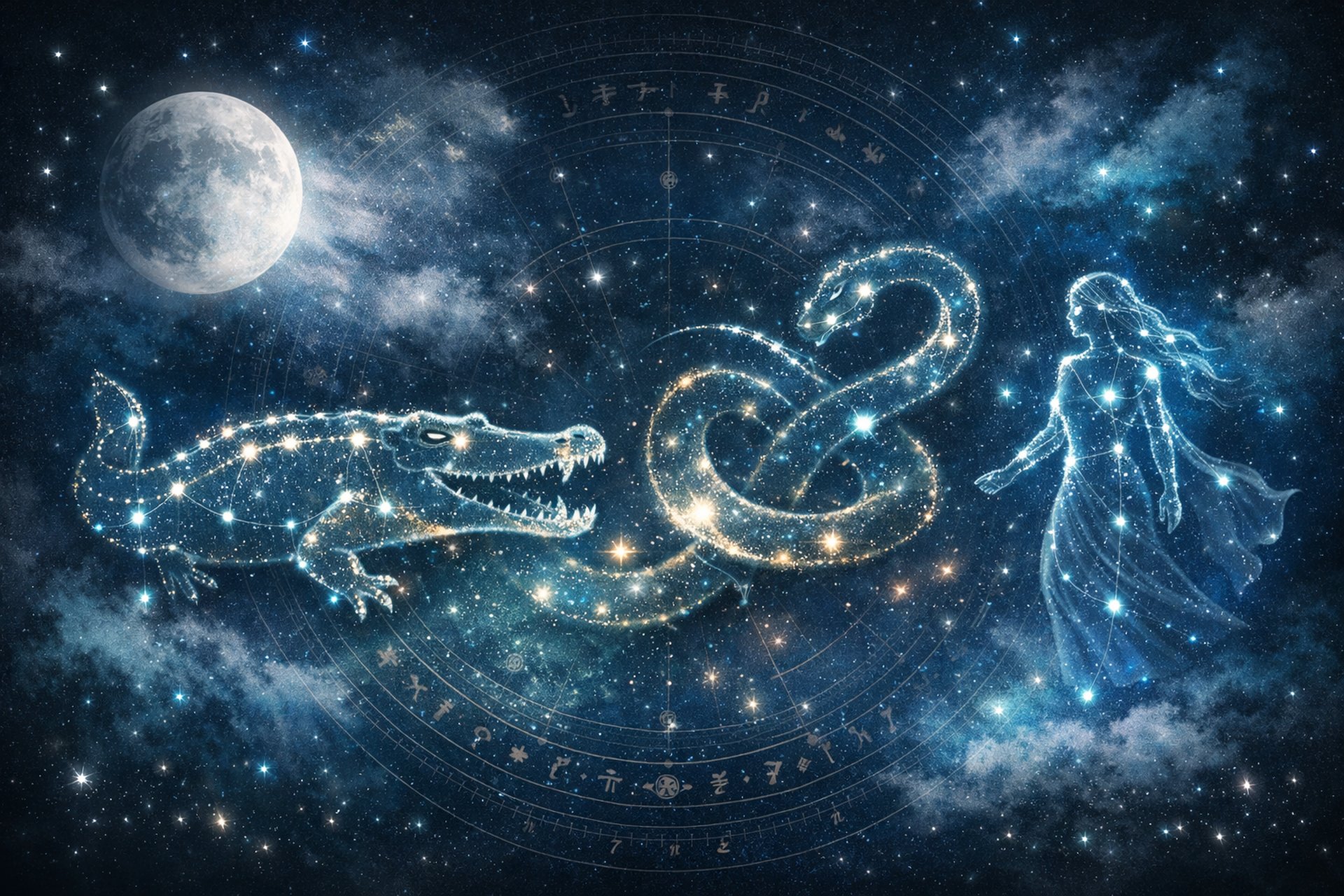
Sobek is the crocodile-headed god born from the deep waters of creation — a being of raw instinct, divine fury, and unexpected tenderness. Worshipped for thousands of years, he embodies the Nile’s dual nature: life-giving abundance and sudden, merciless danger.
Feared as “pointed of teeth” and “he who loves robbery,” Sobek is a predator-god who devours obstacles with the same hunger he protects his chosen. Yet beneath the violence lies a sacred paradox: Sobek is also the healer who reassembled the broken body of Osiris, the guardian who shields the innocent, and the solar force who rises each dawn as Sobek‑Ra, carrying the sun across the sky.
Kings claimed his strength. Warriors prayed for his ferocity. Mothers offered crocodile eggs for his blessing, trusting his fierce devotion — the same devotion seen in crocodiles who carry their young gently in their jaws.
Across the Faiyum, his temples overflowed with mummified crocodiles, living incarnations of the god raised in sacred pools. Priests called him “the uniter,” the one who binds what has been torn apart. In every myth, Sobek stands as the embodiment of primal power tempered by loyalty, a god who destroys to protect, and protects with the full force of destruction.
In your world, Sobek is not merely a deity — he is the river’s heartbeat, the shadow beneath the surface, and the relentless guardian who watches from the water’s edge.


Sobek
The Sea’s Whisper


Under the moon’s quiet gaze, Arsine drifts across the water — a girl caught between the mortal and the divine. Her bronzed hair glows like dusk‑lit copper, her green eyes mirror the restless sea, and her silence carries the weight of forgotten tides. She is the watcher of horizons, the one who listens when the ocean speaks. In her solitude, the world feels both infinite and heartbreakingly close.Write your text here...
Arsine
The Moon’s Conduit
Beneath the silver gaze of the moon, Lilith stands at the altar — a vessel of power and defiance. Her violet eyes burn with purpose, her hands raised to meet the light that answers her call. The ruins whisper her name as the night bends around her will. She is both seeker and storm, the one who dares to touch the divine and reshape its silence into command.Write your text here...


Lilith
The Island Between Worlds
Long before the age of men, Patmos slept beneath the waves — a dream of stone and silence hidden in the Aegean depths. Only when the moon rose did its outline shimmer like a secret remembered by the sea. The goddess of the hunt, Artemis, saw it glisten beneath her light and desired it for her own. Yet even she could not lift it from the abyss. So she called upon her twin, Apollo, whose voice reached Zeus, and through divine accord, Poseidon released his claim. Thus, the island ascended — born of moonlight, song, and divine will.
The mortals who followed Artemis named it Litois, the daughter’s isle, a place where the veil between heaven and earth thinned. Centuries later, its sanctity deepened when a man named John, exiled by empire, heard the voice of eternity echo through its cave. His revelation became scripture, and Patmos became known as the Island of the Apocalypse — the place where endings and beginnings converge.
Now, in your mythos, Patmos stands as a threshold realm — where moonlight awakens memory and the divine stirs beneath the surface. It is said that Lilith once stood upon its altar, her hands raised to the heavens, calling the light that first lifted the island from the sea. Sobek’s power sleeps beneath its waters, and Arsine’s gaze meets its horizon. Patmos is not merely an island — it is the pulse between revelation and rebirth.


Patmos
The Moon and the Crocodile
Born in the shadowed sanctuaries of ancient Egypt, the Cult of Sobek rose where the Nile carried both life and mystery. Its priests devoted themselves to the crocodile god who governed strength, fertility, and the untamed river — yet their devotion did not end with him. They honored Lilith, the moon‑touched goddess who moved between water and night, whose presence stirred longing, awe, and transformation. Together, Sobek and Lilith shaped a faith that blended reverence with intensity, ritual with emotion.
Across Egypt’s sacred cities, worshipers brought offerings of wine, fragrant oils, and fine woven cloth to altars lit by moonlight. They believed the river’s pulse echoed the heartbeat of creation — that each ripple carried Sobek’s power and Lilith’s quiet influence. Their ceremonies bound water, moon, and mortal devotion, forming a tradition known for its dramatic displays of faith and its deep emotional fervor.
To the Cult, Sobek was not merely a guardian of the Nile but a force of awakening. Lilith, his counterpart, embodied the call that stirred the divine to rise. In your mythos, she seeks to stand beside Sobek as a sovereign of Egypt — not in conquest, but in shared dominion, guiding the land through moonlight and river‑born power. Together, they represent a union of strength and mystery, shaping a legacy that endures in whispered stories and ancient stone.

